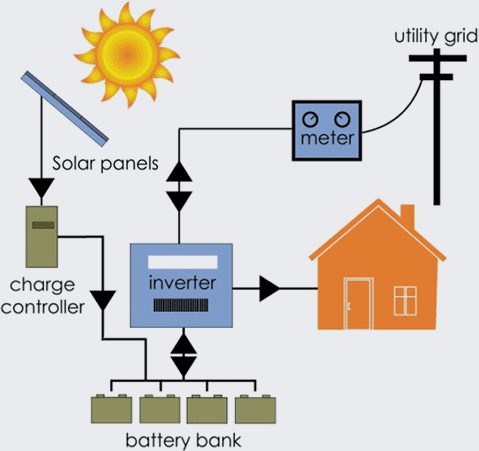

Transitioning to a solar and battery system is a significant investment that requires balancing your current energy needs with future flexibility. Given your interest in community projects and technical systems, you’ll likely appreciate a structured approach to the "readiness" phase.
Here are the key considerations and tips for a household before installing a backup power system.
1. Audit Your Load (The "Needs" vs "Wants")
Before buying hardware, you must know what you actually need to power.
- Essential Load: Lights, Wi-Fi, fridge/freezer, and security systems (CCTV, electric fences).
- Non-Essential Load: Geysers, stoves, air conditioning, and pool pumps.
- Tip: Look at your last 12 months of electricity bills. In South Africa, an average middle-class household uses about 900–1,100 kWh per month. Calculating your daily average (Total ÷ 30) helps size the battery bank.
2. Inverter Selection: Pure Sine Wave is Non-Negotiable
- Type: Always choose a Hybrid Inverter. It can manage power from solar panels, the grid, and batteries simultaneously.
- Quality: Cheap "Modified Sine Wave" inverters can damage sensitive electronics like LED TVs, computers, and fridge motors. Ensure it is a Pure Sine Wave unit.
- Sizing: A 5kW inverter is the standard for a medium home, but if you plan to use a microwave or air fryer while the power is out, you may need an 8kW unit to handle the "surge" or "peak" demand.
3. Battery Tech: Lithium-Ion is the Standard
Avoid Lead-Acid or Deep Cycle Gel batteries if your budget allows.
- Lifespan: Lithium-Ion batteries (specifically LiFePO4) last 10+ years (approx. 6,000 cycles), whereas Gel batteries often fail within 1-2 years if discharged deeply during frequent outages.
- Depth of Discharge (DoD): You can safely use 80-90% of a Lithium battery’s capacity. Gel batteries should rarely be taken below 50%, effectively doubling the "size" you need to buy to get the same usable power.
4. Roof and Structural Readiness
- Orientation: In the Southern Hemisphere (like Durban/eThekwini), panels should ideally face True North at an angle of roughly 25° to 35°.
- Shading: Even a small shadow from a chimney or a tree can drop a panel's efficiency by 50% or more.
- Condition: If your roof needs waterproofing or repair, do it before the panels go up. Removing and reinstalling a 10-panel array later is an expensive labor cost.
5. Compliance and Legalities
- SANS Standards: Ensure the installer is registered and will provide a Certificate of Compliance (CoC). Without this, your household insurance may not cover fire or electrical damage.
- Municipal Registration: Many South African municipalities (including eThekwini) require you to register "embedded generation" (solar) systems.
- Fire Safety: National regulations (SANS 10400-T) prohibit installing large lithium batteries in living areas (bedrooms/lounges). They should be in a garage or a dedicated, ventilated space.
Comparison Table: System Sizes (Typical)
| House Size | Inverter | Battery Storage | Panels | Use Case |
| Small | 3kW - 5kW | 5kWh | 4 - 6 | Essentials, Wi-Fi, TV, Fridge |
| Medium | 5kW - 8kW | 10kWh | 8 - 12 | Above + Dishwasher/Washing Machine |
| Large | 8kW - 12kW | 15kWh+ | 14+ | Full home backup incl. Geyser/AC |
Always consult a Professional for Designing and installing your Solar/Hybrid System